
BFSI Digital Transformation Case Study
Valora – OTC Derivatives Valuation Platform
Global OTC Derivatives Valuation Platform Modernization
Financial-services transformation is especially difficult when pricing, risk, operations, security, and auditability depend on fragmented legacy systems.
This case study highlights the transformation of Valora, a global OTC derivatives valuation platform created to unify pricing workflows, normalize data, automate validation, improve governance, and support scalable global operations.
The initiative helped move the institution from siloed pricing environments to a single, trusted valuation platform capable of supporting complex derivatives operations across multiple regions and asset classes.
Overview
A leading financial institution relied on two legacy pricing systems that emerged from the merger of two large institutions. Each system had strengths, but the combined environment created duplicated workflows, operational silos, manual touchpoints, and limited transparency.
The organization needed a single global pricing engine that could support OTC derivatives valuation while improving efficiency, oversight, scalability, and user access control.
The transformation focused on creating a unified, browser-based global application that integrated multiple data sources, normalized pricing, automated validation, and supported a stronger governance model.
The Challenge: Fragmented Systems, Duplicated Workflows & Operational Complexity
The institution’s pricing operations were constrained by two legacy platforms that operated in silos. This created inefficiency, operational risk, and challenges in scaling the platform to support future business needs.
Key Challenges Included
- Fragmented pricing workflows across legacy systems
- Redundant processes created by merger-driven system overlap
- Manual touchpoints that increased inefficiency and error risk
- Limited transparency in price validation and audit workflows
- Difficulty scaling to new asset classes
- Difficulty integrating new pricing vendors
- Difficulty connecting with additional accounting platforms
- Need for stronger access control, security, and auditability
The vision was to create one trusted pricing engine that could support global operations while enabling better oversight and faster time-to-market.
The Approach: Platform Consolidation, Automation and Governance
The transformation required more than a technical migration. It required a careful comparison of legacy platforms, a future-state architecture, stakeholder alignment, data normalization, workflow redesign, and a phased adoption strategy.
1. Functional and Architectural Assessment
The team conducted a comprehensive comparison of the legacy systems to identify strengths, overlaps, gaps, dependencies, and future-state requirements.
Focus areas:
- Legacy system capability comparison
- Functional overlap and gap analysis
- Architecture review
- Business workflow assessment
- Migration and consolidation planning
2. Global Platform Architecture
The future-state architecture centered on one global browser-based application that could serve multiple regions, user groups, asset classes, and pricing workflows.
Focus areas:
- Single global application model
- Browser-based delivery
- Scalable architecture
- Region and asset-class support
- Integration readiness for pricing and accounting platforms
3. Data Integration and Pricing Normalization
The platform integrated multiple data sources and normalized pricing information to create a more reliable foundation for valuation workflows.
Focus areas:
- Multiple pricing-data sources
- Data normalization
- Reference-data consistency
- Reduced duplication
- Improved operational reliability
4. Automated Price Validation
A major part of the transformation involved automating price scrubbing and outlier detection with full transparency.
Focus areas:
- Automated price scrubbing
- Outlier detection
- Validation transparency
- Exception handling
- Improved oversight
5. Security, Access and Auditability
The platform introduced stronger controls through tiered user access, enhanced security, and extensive audit trails.
Focus areas:
- Tiered user permissions
- Role-based access
- Security enhancement
- Audit trails
- Governance and oversight
6. Agile Delivery and Phased Rollout
The initiative used iterative agile delivery, continuous testing, feedback cycles, and phased rollout across global pricing groups to reduce adoption risk.
Focus areas:
- Iterative delivery
- Continuous testing
- User feedback
- Phased rollout
- Global adoption planning
What Was Delivered
The transformation delivered a stronger global platform foundation for OTC derivatives valuation and pricing operations.
Deliverables included:
- Functional and architectural comparison of legacy platforms
- Future-state Valora architecture
- One global browser-based pricing application
- Integrated pricing-data sources
- Normalized pricing workflows
- Automated price scrubbing
- Outlier detection
- Enhanced transparency in validation
- Tiered user access
- Stronger security controls
- Extensive audit trails
- Agile delivery model
- Phased global rollout plan
The Impact
The initiative established Valora as a trusted global pricing and reference-data hub for OTC derivatives operations. The project improved efficiency, transparency, oversight, scalability, and the organization’s ability to evolve pricing operations over time. It set a new benchmark for operational efficiency, transparency, and global scalability in derivatives pricing.
Valora is now a trusted reference data hub and a model for continuous improvement and innovation in financial services operations.
Impact Highlights
The transformation created a scalable global platform for derivatives pricing, improving automation, transparency, security, auditability, and operational oversight.
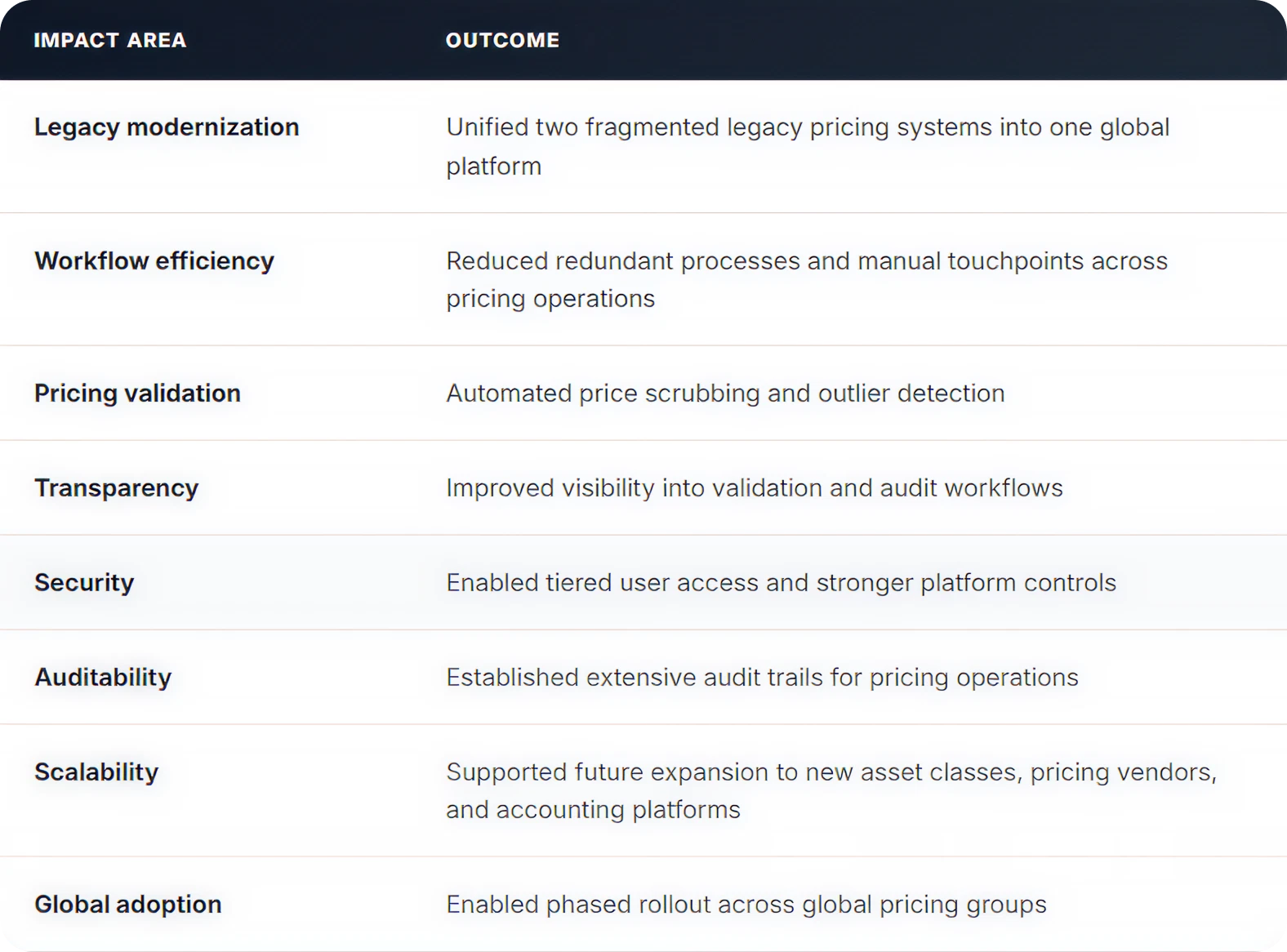
Outcomes reflect platform modernization, workflow redesign, pricing automation, governance, and global adoption planning for complex BFSI operations.
Industry Recognition
The initiative received an Internal Team Award for Vision and Delivery, recognizing the successful transformation of complex pricing operations into a scalable global platform foundation.
Why Platform Modernization Matters in BFSI
BFSI organizations operate in environments where accuracy, trust, security, transparency, and auditability are non-negotiable. Legacy platforms can create operational risk when workflows are fragmented, data sources are inconsistent, and validation logic depends heavily on manual intervention.
Modernizing complex financial platforms can help institutions:
- Improve operational efficiency
- Reduce manual error risk
- Strengthen transparency and auditability
- Improve pricing and validation oversight
- Support regulatory and internal governance needs
- Scale to new products, vendors, and regions
- Improve user access control and security
- Create a foundation for future analytics and automation
For capital-markets and derivatives operations, digital transformation is not only about technology modernization. It is about improving trust, control, speed, and scalability across mission-critical workflows.
Related Axionix Capabilities
This study reflects Axionix capabilities across:
- BFSI digital transformation
- Capital-markets platform modernization
- Legacy system consolidation
- Workflow modernization
- Pricing operations transformation
- Data integration and normalization
- Automation and exception management
- Governance and auditability design
- Security and access-model design
- Agile transformation delivery
- Global rollout and adoption planning
Explore Transformation Services
View more Case Studies